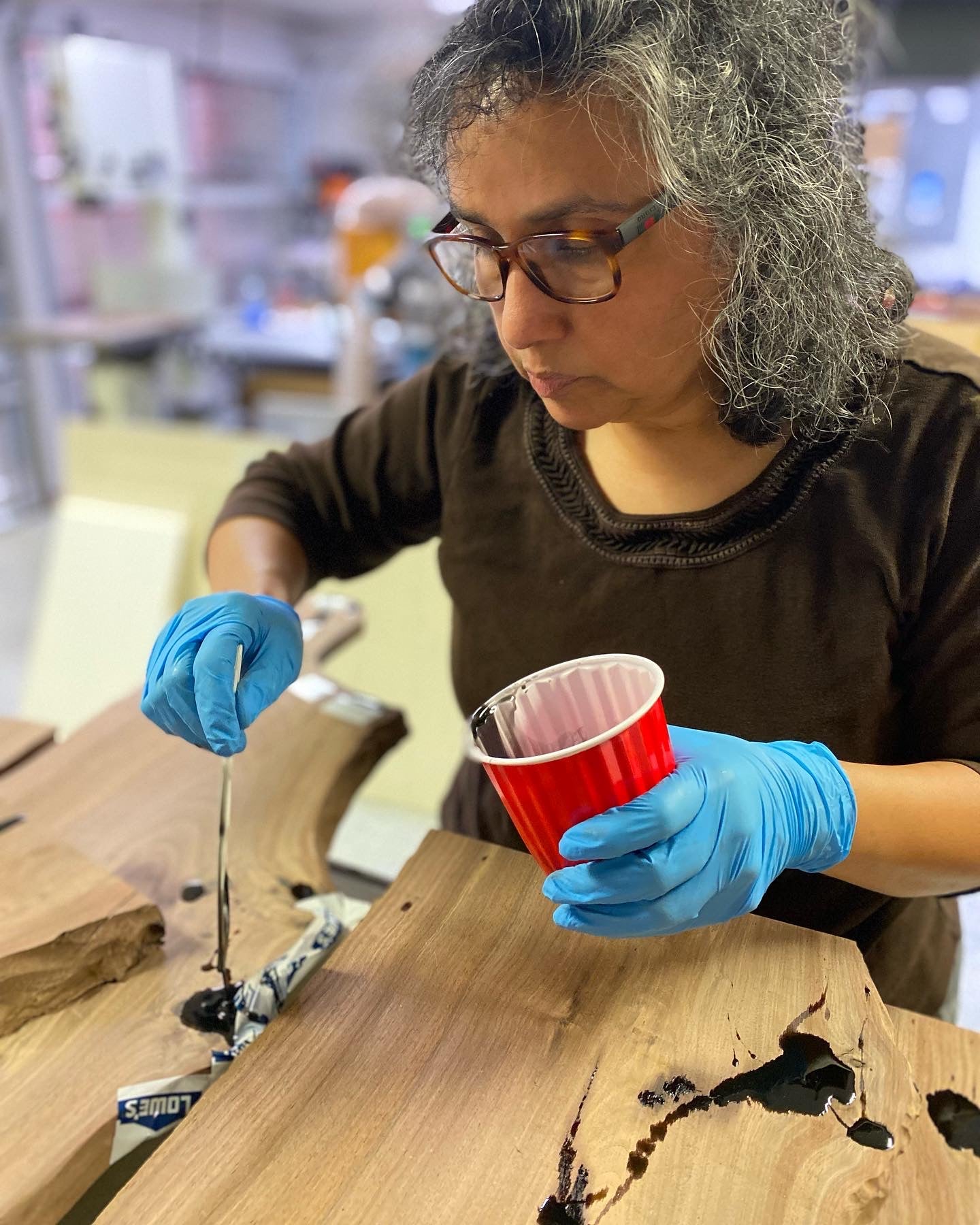
I didn't start woodworking to build a business. I started because I needed to make something with my hands — something slow, something real. I'm a physician. My days are spent in the abstract: diagnoses, decisions, documentation. Wood was the opposite of all that. It pushed back. It had grain and weight and smell. It required me to actually pay attention.
What I didn't expect was how much I'd start thinking about furniture differently — not just the pieces I was making, but the ones already in my home, in my patients' homes, in every store I walked into. Once you've worked with solid hardwood, the difference becomes impossible to unsee.
## The wood has a history before you touch it
Most furniture is built around predictability. Factories want wood — or something wood-adjacent — that behaves the same every time. Same grain, same density, no surprises. The knots get cut out. The character gets sanded away. What's left is a surface that could have come from anywhere, made by no one in particular.
I work with salvaged Texas hardwoods, mostly black walnut. The slabs I use came from trees that actually grew here — in this heat, through these droughts. You can read that in the grain if you know how to look. The rings get tighter in dry years. The figure shifts where a branch once was. The live edge follows the exact outline of the tree's outer bark, which means no two boards ever look the same, and no two tables ever will.
That's not a selling point I invented. It's just what the material is.
> There's something about running your hand across a walnut slab that no photograph captures. It's the weight of it. The way it's still slightly warm.
## Hundreds of small decisions
Building a piece of furniture by hand means making choices constantly — which face of the board goes up, how to account for wood movement, where the joinery goes, how much material to remove and how much to leave. None of that is automated. It requires judgment, and judgment takes time to develop.
I think about this a lot as a doctor. In medicine, we talk about the difference between knowing the protocol and actually treating the patient in front of you. The protocol handles the average case. The patient in front of you almost never is the average case. Woodworking is similar. The wood in front of you is never quite what the textbook described.
## It's built to last — and to be fixed when it doesn't
Mass-produced furniture has a designed lifespan. The materials are chosen to meet a price point, not to last decades. When something breaks, replacing it is cheaper than repairing it. That's not an accident; it's the business model.
Solid hardwood with honest joinery works differently. You can take it apart. You can refinish it when the surface wears. You can repair it when something gives. A well-built walnut table can outlive the person who commissioned it — and the next owner, and the one after. That's not sentiment. It's just what the material allows when you don't cut corners on how it's put together.
## What you're actually getting
When I build something, I know exactly where the wood came from, how long it dried, what I was thinking about when I cut the joints. That specificity is embedded in the object. It doesn't disappear when the piece leaves my studio.
A handmade piece isn't just furniture for a room. It's an object that came from somewhere, made by someone who made real decisions — about your space, your light, how you live. That's what's different. And once you feel it, it's hard to go back to the alternative.
*If you've ever stood in a furniture store and felt like nothing in it was quite right — you might already know what I mean.*
— Saima
Founder, Mindful Creations Woodworking · San Antonio, Texas
Interested in a custom piece built specifically for your home? Explore our collection or contact Mindful Creations Woodworking to discuss your project.